LCP
Largest Contentful Paint
≤ 2.5
seconds
When the main hero image, product photo, or PDP gallery is fully drawn. The single best proxy for "did the page load yet?"
 Adobe Commerce specialists · since 2015
A focused engagement to diagnose, fix, and certify the server performance of your Adobe Commerce site — with a contractual guarantee on Time to First Byte and server response time, run by senior engineers who've shipped on the platform since 2015.
Adobe Commerce is powerful and complex. Without disciplined performance work, that complexity surfaces as long server response times, layout that jitters into place, and checkouts that stall. Google measures it, your shoppers feel it, and your conversion rate reflects it.
Google's Core Web Vitals describe the field-measured experience of real shoppers loading your site. We treat these as contractual targets, not vanity metrics: every engagement ships with before/after CrUX-validated readings.
When the main hero image, product photo, or PDP gallery is fully drawn. The single best proxy for "did the page load yet?"
The slowest tap, click, or keystroke a real shopper hits all session. Where Adobe Commerce's add-to-cart, mini-cart, and filter taps live or die.
How much content jumps around as the page loads. Reserved space on PDP galleries, banners, and dynamically-injected blocks.
The server-side number. On Adobe Commerce this is the one that drags everything else down — and the one full-page caching, FPC tags, and Varnish are supposed to fix.
Time to First Byte is the gap between the request leaving the browser and the first byte of HTML coming back. On Adobe Commerce, that gap is where unindexed catalog queries, layered navigation rebuilds, third-party module hooks, and missed full-page cache opportunities accumulate. Fix TTFB and LCP follows.
We treat TTFB as the tip of the iceberg — and we go after the iceberg: PHP-FPM tuning, OPcache and Redis sizing, Varnish hit-rate, indexer mode, ElasticSearch / OpenSearch latency, FPC tag explosion from misbehaving modules, MySQL slow-query log, and CDN origin-shielding configuration.
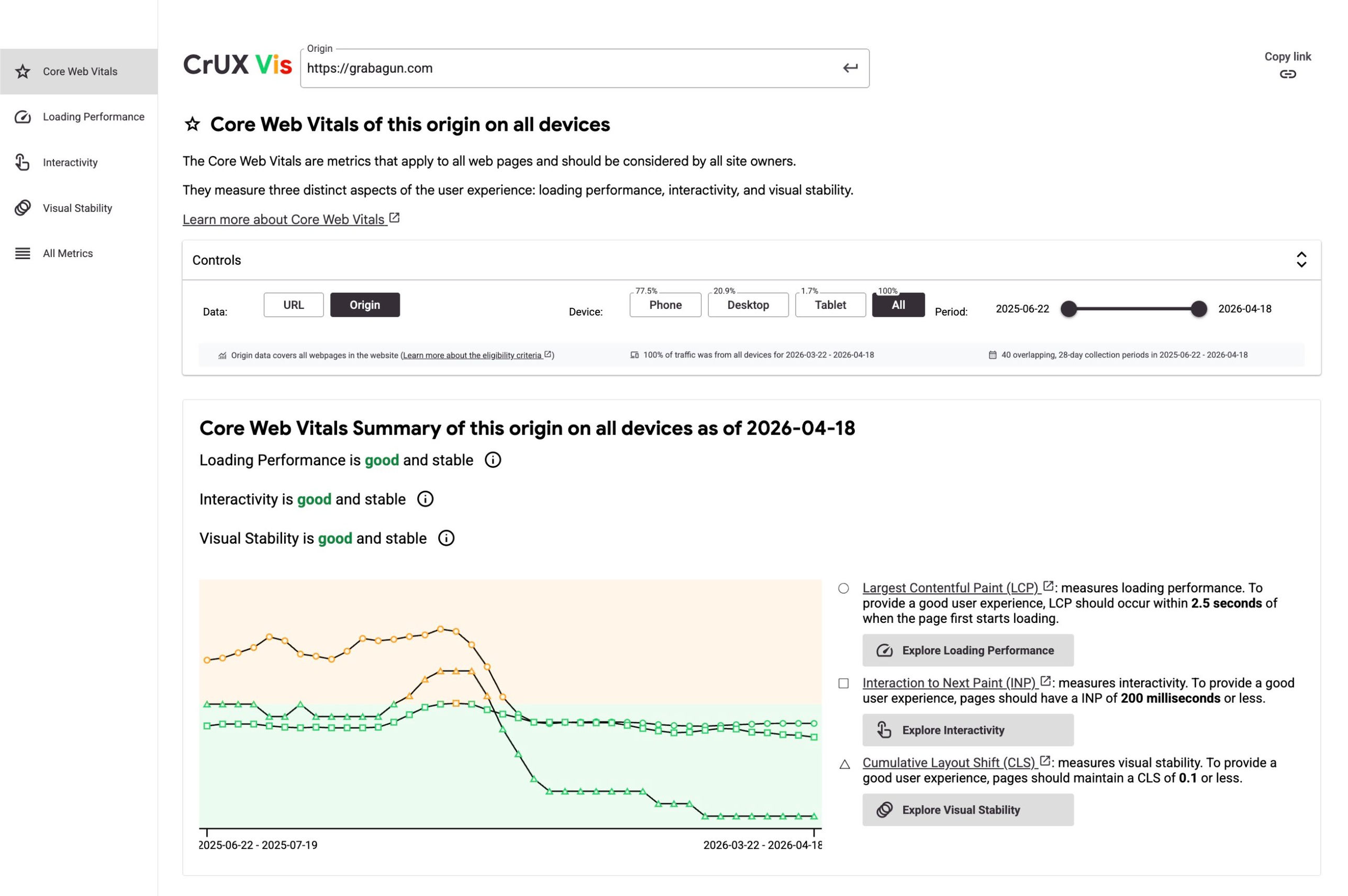
The chart on the left is the Chrome User Experience Report — the same field data Google uses to assess your site for ranking. Orange is poor; green is good. Watch what happens when the work lands.
Down from a long stretch of "needs improvement" through summer 2025.
Add-to-cart and filter interactions stayed responsive under peak load.
Reserved height on PDP gallery, hero banners, and lazy-loaded promo blocks.
We agree on a contractual Time to First Byte target at the end of Phase 01 — written into the SOW, validated against 28-day CrUX field data. If we don't hit it, you owe nothing for Phase 02. We focus the guarantee on TTFB because it's the metric we control end-to-end on Adobe Commerce: PHP, Varnish, Redis, ElasticSearch, MySQL — our work, our number. We can offer this because we've been shipping on this platform since 2015 and we know what's actually achievable on your stack before we sign.
We don't sell a fixed audit checklist. We diagnose against your real Adobe Commerce codebase, your real third-party stack, and your real CrUX history — then commit — contractually, in writing — to the specific Core Web Vitals and TTFB targets before we start fixing.
A two-week deep read of the site against field data, lab data, and the codebase itself. We deliver a written report with prioritized findings and committed targets.
Senior engineers implement the prioritized fixes against your repo and staging environment. We work in your branching model, write tests, and submit pull requests to your team for review.
We don't leave until the field data agrees with the lab data. Then we hand off dashboards and alerting so the gains hold past the engagement.
A general-purpose Web Vitals audit will miss the Adobe-Commerce-shaped problems. This is what our senior engineers actually pull apart, in language your dev team will recognize from sprint planning — informed by a decade of shipping on the platform since 2015.
Cache-tag explosion from poorly-built modules, VCL grace + keep tuning, ESI for mini-cart and customer blocks, hit-rate audits per route.
Separate connections for cache vs. session vs. FPC, eviction policy review, pipelining for cart operations, sentinel-aware client config.
Index sharding, query profile review on layered navigation, synonym performance, swatch attribute aggregation cost, suggester latency.
Indexer mode (update on save vs. schedule), slow-query log triage, EAV join cost on PDP, and partial reindex strategy for large catalogs.
RequireJS bundling vs. Baler, critical-path inlining, KnockoutJS hot paths, mini-cart JSON payload size, and font-display strategy.
Plugin ordering, observer cost, around-plugin overuse, deprecated layout XML patterns, and the small handful of well-known performance offenders.
Every project is scoped against your specific site, stack, and traffic profile — not a fixed-price audit template. The price reflects the size of the catalog, the complexity of the third-party module estate, and the targets we contractually commit to.
Email sales@krakencommerce.comScoped and priced after a free 30-minute intro call.
Includes diagnosis, prioritized findings, and the contractual TTFB / server response time target we're prepared to guarantee on your site.
Built to slot into your team's rhythm, not replace it. We work in your repo, your branch model, and your sprint cadence.
Codebase access, environment walkthrough, agreement on the contracted Core Web Vitals and TTFB targets.
Field + lab profiling, module audit, infrastructure review. Written report with prioritized findings.
PRs against your repo, reviewed by your team. Weekly demos against staging Lighthouse runs.
28-day CrUX validation, RUM dashboards, performance budgets in CI, runbook handoff.
We're not a "full service" agency; we don't offer UX optimization, SEO, paid search, or other marketing services. Our goal is to be the best development-focused eCommerce agency and to partner with your in-house team or marketing agency.
Send us your URL and a sentence about what you're seeing. We'll come back inside two business days with a free read of your current CrUX field data and whether a performance engagement is the right fit.
sales@krakencommerce.com →